Agricultural Engineer
Apply engineering principles to solve the Food-Energy-Water puzzle. Design drones, automated systems, and sustainable technologies for modern farming.
Career Overview
Understanding the fundamentals of Agricultural Engineer
Precision Farming
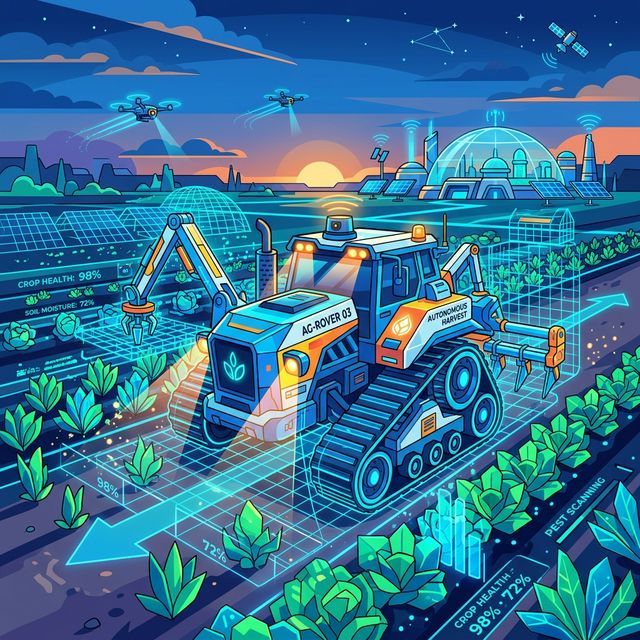
Use drones for soil mapping and precision robotic harvesters that don't bruise delicate fruits.
Resource Optimization
Solve the Food-Energy-Water puzzle for 1.4 billion people with smart systems.
Smart Systems
Design automated irrigation and high-tech processing systems that save water and energy.
What is This Career All About?
Engineering solutions for modern agriculture.
The Brain and Hands: If a Farmer is the 'Heart' of Indian agriculture, an Agricultural Engineer is the 'Brain' and 'Hands' that make the system smarter and more powerful.
Agricultural Engineering is the branch of engineering that applies the principles of science and technology to agricultural production and processing.
Beyond Tractors: It's not just about tractors; it's about using drones to map soil health, designing automated irrigation systems that save every drop of water, and creating robotic harvesters that can pick delicate fruits without bruising them.
Solving the Puzzle: With a population of over 1.4 billion, we need to grow more food using less land and less water. Agricultural Engineers solve the 'Food-Energy-Water' puzzle.
Modern Industry: They ensure that farming is not just a tradition, but a high-tech, profitable, and sustainable industry for the 21st century.
Global Priority: In today's India, this career is a global priority as we become a leader in agricultural innovation.
A Day in the Life: Arjun, Agricultural Engineer at Agri-Tech Startup
Real workflow of an agricultural engineer.
The Field Briefing
Arjun starts his day on a sprawling farm in Pune. He isn't holding a shovel; he's holding a tablet. He's checking the telemetry data from a fleet of autonomous tractors currently tilling the soil. One tractor has flagged a sensor error, and Arjun quickly recalibrates the GPS settings from his screen.
Drone Scouting
He launches a thermal-imaging drone to fly over the 50-acre wheat field. As the drone sends back live data, Arjun identifies a 'stressed' patch of crops that isn't getting enough nitrogen. He sends a command to the automated sprinkler system to deliver a precise dose of liquid fertilizer to only that specific patch. This is Precision Agriculture in action.
Designing the Future
After lunch, Arjun heads to the R&D lab. He's working on a 3D model of a new 'Solar-Powered Cold Storage' unit. In India, 40% of fresh produce is wasted due to heat. Arjun's design uses affordable, locally sourced materials and solar panels to keep vegetables fresh in remote villages without electricity.
The Client Meeting
He meets with a group of local farmers to explain how a new moisture-sensing probe works. He translates complex engineering jargon into simple language, showing them how they can save 30% on their water bills.
Data Analytics
Before leaving, Arjun reviews the day's data logs. He prepares a report for his manager on how the new robotic seeder performed compared to manual labor. As he drives home, he sees the green fields and feels proud—he didn't just 'work' today; he helped secure the food on a thousand plates.
Is This You? Personality Traits & Skills Required
Self-assessment for the ideal candidate.
Mechanical Interest
You like building things, fixing broken toys, or understanding how engines run.
Analytical Mind
You enjoy Math and Physics and like using data to solve puzzles.
Environmental Sensitivity
You care about nature, water conservation, and climate change.
Resilience
You are comfortable spending time in the sun and dust of a farm as much as a clean, air-conditioned lab.
Problem-Solving Skills
When a machine breaks or a crop fails, you don't panic—you look for the 'Why' and the 'How to fix.'
Key Responsibilities & Workflow
The complete agricultural engineering cycle.
Requirement Analysis
Talking to farmers or companies to understand a problem (e.g., 'We are losing too much water during irrigation').
Design & Modeling
Using software like AutoCAD or SolidWorks to design a solution (e.g., a smart drip-irrigation valve).
Prototyping
Building a small version of the machine or system in a lab.
Field Testing
Taking the prototype to a real farm to see if it works under heat, rain, and mud.
Quality Control
Ensuring the final product follows safety codes and is durable.
Maintenance & Support
Teaching others how to use the technology and fixing it if it malfunctions.
Career Pathways in India
Educational journey from Class 10 onwards.
Pathway A
B.Tech Route
Step 1
Complete Class 12th with PCM (Physics, Chemistry, Maths)
Step 2
Clear JEE/State CET and pursue B.Tech Agricultural Engineering (IITs, SAUs, GBPUAT)
Step 3
Do internships at ICAR, farm machinery companies, or agri-tech startups
Step 4
Learn tools — AutoCAD, MATLAB, GIS, drone technology
Step 5
Pursue M.Tech or MBA in Agri-Business (optional)
Step 6
Join as Agricultural Engineer, Farm Machinery Designer, or Irrigation Specialist
Pathway B
Diploma + Field Entry Route
Step 1
Complete Class 10th/12th with Science
Step 2
Pursue Diploma in Agricultural Engineering (3 years, state polytechnics)
Step 3
Gain field experience — FPOs, KVKs, farm equipment dealers
Step 4
Learn basics — soil testing, irrigation systems, tractor mechanics
Step 5
Upgrade through lateral entry to B.Tech (optional)
Step 6
Work as Junior Engineer, Field Technician, or Agri-Equipment Supervisor
Pathway C
Research + Government Route
Step 1
Complete Class 12th with PCM
Step 2
Pursue B.Tech Agricultural Engineering
Step 3
Clear GATE and pursue M.Tech (IITs, IARI, CIAE Bhopal)
Step 4
Publish research in farm mechanization, renewable energy, or water management
Step 5
Clear ARS/NET, UPSC Engineering Services, or State PSC exams
Step 6
Join as Scientist at ICAR, Professor, or Government Engineer in agriculture department
Market Snapshot — India 2026
Salaries, growth, and opportunities.
Salary Snapshot (Annual INR)
| Career Level | Est. Salary (p.a.) |
|---|---|
| CXO / Top Leadership (15+ yrs) | ₹40 LPA – ₹1.5+ Crore |
| Senior / Lead Role (10+ yrs) | ₹12–40 LPA |
| Mid-Level Professional (5–8 yrs) | ₹6–20 LPA |
| Junior / Associate (3–5 yrs) | ₹4–10 LPA |
| Entry Level (0–2 yrs) | ₹3–7 LPA |
Note
Metro/agri-industrial hubs (Pune, Hyderabad) pay 15–30% higher
skills in irrigation tech, GIS, farm mechanisation boost salary by 20–40%.
Where Are the Jobs?
Top cities and industries.
Top Industries
Farm Machinery (Tractors/Harvesters), Irrigation Systems, Food Processing, Agri-Tech Startups, Renewable Energy (Biofuels)
Top Companies
Mahindra & Mahindra, John Deere, TAFE, Jain Irrigation, ITC, Nestlé, Amul
Government Sector
ICAR (Scientist), FCI (Technical Officer), State Water Resources Departments, NABARD
Remote Work
High for Design Engineers, Data Analysts, and Remote Sensing specialists
International
Huge demand in the USA, Germany, and Israel for Indian engineers with expertise in tropical agriculture
Top Cities
Hyderabad, Pune, Bengaluru, Delhi-NCR, Ludhiana, Coimbatore
What Will It Cost?
Course fees and additional expenses.
Government Institutions
₹50,000 – ₹2,50,000 (Total 4-year degree fees)
Private Institutions
₹4,00,000 – ₹12,00,000 (Total 4-year degree fees)
Duration
4 Years (B.Tech)
Living/Hostel Costs
₹8,000 – ₹15,000 per month in cities like Pantnagar, Ludhiana, or Coimbatore
Additional Costs
High-end laptop (₹60k+), certification exams (₹5k–₹15k)
Where to Study?
Top institutions across India.
Government
- •Indian Institute of Technology Kharagpur (IIT-KGP)
- •Punjab Agricultural University (PAU) Ludhiana
- •Tamil Nadu Agricultural University (TNAU) Coimbatore
- •Govind Ballabh Pant University of Agriculture & Technology Pantnagar
Private
- •SRM Institute of Science and Technology Chennai
- •Amity University Noida
- •Lovely Professional University (LPU) Jalandhar
- •Sharda University Greater Noida
Online
- •IGNOU
- •Swayam/NPTEL
- •Coursera (IIT/IARI courses)
- •ICAR e-courses
Scholarship Opportunities
Financial assistance programs.
Central
NSP (National Scholarship Portal), AICTE Pragati (₹50k/year for girls)
ICAR
National Talent Scholarship (NTS) for students moving to a different state for studies
State
e.g., Krishi Vidya Nidhi (Odisha) or MOMA scholarship for minorities
Private
Corteva Agriscience Scholarship (₹25k–₹50k) for students in agri-allied streams
Professional Bodies & Certifications
Credentials and regulatory requirements.
ISAE (Indian Society of Agricultural Engineers)
The primary professional body for networking
Certifications
Drone Pilot License (DGCA approved), GIS & Remote Sensing (IIRS/ISRO), Data Analytics (Google/IBM)
Career Opportunities
Conventional and emerging roles.
Conventional Careers
Farm Machinery Design
Irrigation Engineer
Soil & Water Conservationist
New-Age / AI-Driven Careers
Drone Data Analyst
Precision Agriculture Specialist
Climate-Smart Systems Engineer
AI-Agriculture Specialist
Freelancing & Entrepreneurship
Independent Farm Consultant
Custom Hiring Center (CHC) Entrepreneur
Agri-Visualization Specialist
Challenges and Realities
The hard truths of the profession.
Physical Environment
You will often work in dusty, hot, and muddy conditions
Seasonal Peak
During harvest seasons, your workload might triple
Translational Gap
Designing a machine in a lab is easy; making it work for a small Indian farmer with a 1-acre plot is the real, hard challenge
Field Work Demands
You will spend significant time in challenging field conditions — heat, dust, rain, and remote locations
Weather Dependency
Your work is heavily dependent on weather patterns and seasonal cycles
Technology Adoption
Farmers may resist new technologies; you need patience and communication skills to convince them
Budget Constraints
Many farms operate on tight budgets; solutions must be affordable and practical
Continuous Learning
Agricultural technology evolves rapidly; staying updated with new tools and methods is mandatory
Emerging Trends (2025–2035)
What's next in agricultural engineering.
The Drone Revolution
By 2030, drones will be used for everything from spraying pesticides to planting seeds
Vertical Farming
Engineering farms inside urban skyscrapers to grow 'Zero-Mile' food
AI & IoT
Sensors in the soil that 'talk' to the farmer's phone, telling them exactly when the plant is thirsty
Precision Farming
Advanced data analytics and machine learning for crop optimization
Renewable Energy
Integration of solar and biogas systems in agricultural operations
Skills to Build While Still in School
Actionable steps to start your journey.
Science & Math
Focus on Mechanics (Physics) and Geometry
Coding
Learn basic Python. It's the language of AI and drone data
Observation
Visit a local farm or a 'Kisan Mela.' Ask how a tractor works or why a pump fails
Projects
Build a simple solar-powered lamp or a DIY watering system for your balcony plants
Famous Indian Personalities in Agricultural Engineering
Inspiring figures in the industry.
Dr. A.M. Michael
A pioneer in Irrigation Engineering who revolutionized how India manages its water resources
Vidyut Mohan
A young innovator (Takachar) who turned farm waste into biofuel and won the Earthshot Prize
Bhavarlal Jain
Founder of Jain Irrigation; he pioneered drip irrigation in India, saving billions of liters of water
M.S. Swaminathan
Though a scientist, his vision for 'Farm Mechanization' as part of the Green Revolution paved the way for modern agricultural engineering
Learn More Through Videos
Watch expert insights and student experiences
Agricultural Engineering Career Overview - Engineering the Future of Food
Video 1 of 3