Aquaculture
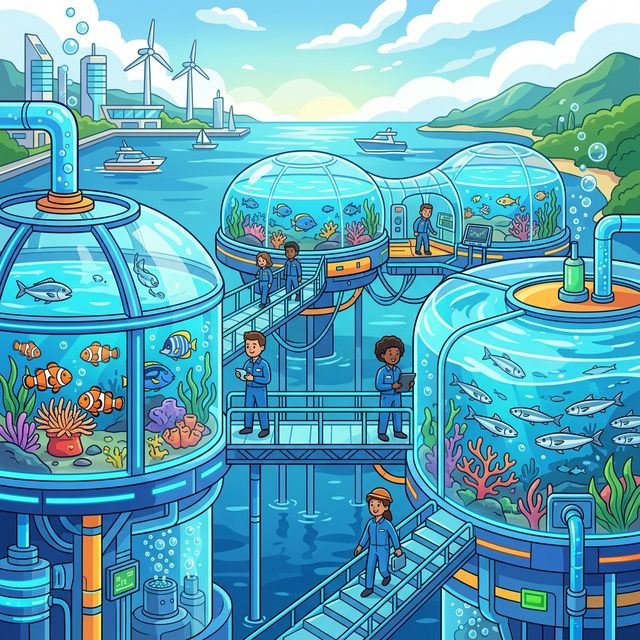
Farming aquatic organisms like fish and shrimp under controlled conditions to feed the world.
Career Overview
Understanding the fundamentals of Aquaculture
Food Security
Provide protein for 1.4 billion people
Market Demand
India is 3rd largest fish producer globally
Global Opportunities
Export shrimp and fish worldwide
What is Aquaculture?
Farming aquatic life under controlled conditions
Aquaculture is farming organisms like fish, shrimp, and oysters under controlled conditions.
India is the world's 3rd largest fish producer and 4th largest exporter.
Government schemes target 55 lakh new jobs in this sector by 2025.
Aquaculture professionals ensure food security while maintaining environmental sustainability.
This career combines biology, technology, and business in a rapidly growing industry.
A Day in the Life: Priya, Aquaculture Manager
Real workflow of an aquaculture professional.
Pre-Stocking Inspection
Priya arrives at the shrimp farm in Andhra Pradesh. She tests water quality—pH, salinity, dissolved oxygen, and ammonia levels. She checks the hatchery for healthy seed stock.
Pond Monitoring
She walks through 10 ponds, observing shrimp behavior and feeding patterns. She adjusts aeration systems and feed quantities based on observations. One pond shows signs of disease—she collects samples for lab testing.
Feed Management
Priya coordinates with the feed supplier. She calculates feed requirements based on shrimp biomass and growth stage. She ensures feed quality and storage conditions.
Disease Diagnosis
In the lab, she tests water and tissue samples. She identifies a bacterial infection in one pond and prescribes treatment protocols. She documents findings in the farm management system.
Harvest Planning
She reviews harvest schedules and coordinates with buyers. She ensures proper sorting, grading, and packaging of harvested shrimp for export.
Data Analysis
Priya updates farm records—feed conversion ratios, survival rates, water quality trends. She uses this data to optimize next season's production and apply for government subsidies.
Is This You? Personality Traits & Skills
Self-assessment for the ideal candidate.
Observant and patient with strong attention to detail
Physically fit for outdoor work in varying weather conditions
Strong problem-solving skills for disease and water quality issues
Competency in water quality testing and aquatic animal nutrition
Comfortable with hatchery operations and aquaculture technology
Business-minded for farm management and market coordination
Key Responsibilities & Workflow
From pond preparation to market sale
Pre-Stocking
Preparing ponds, testing water quality, and selecting healthy seed stock
Growing
Monitoring daily feeding, observing health, managing water parameters
Disease Management
Diagnosing and treating aquatic animal diseases
Harvest
Sorting, grading, packaging, and coordinating with buyers
Record Keeping
Maintaining detailed farm records for optimization and subsidies
Sustainability
Ensuring environmental compliance and waste management
Career Pathways in India
Educational journey from Class 10 onwards.
Pathway A
B.F.Sc Degree Route
Step 1
Complete Class 12th with PCB (Physics, Chemistry, Biology)
Step 2
Clear ICAR-AIEEA/State CET and pursue B.F.Sc — Bachelor of Fisheries Science (4 years — CIFE Mumbai, SAUs, State Fisheries Colleges)
Step 3
Do internships at fish hatcheries, shrimp farms, or MPEDA export units
Step 4
Learn skills — water quality testing, feed management, disease diagnosis
Step 5
Pursue M.F.Sc in Aquaculture / Mariculture / Fish Genetics (optional)
Step 6
Join as Aquaculture Officer, Fisheries Development Officer, or Hatchery Manager
Pathway B
Skill-Based / Entrepreneurship Route
Step 1
Complete Class 10th/12th (any stream)
Step 2
Attend aquaculture training at CIFA, NFDB, KVKs, or state fisheries departments (free/subsidized)
Step 3
Learn basics — pond construction, seed selection, feeding, harvesting techniques
Step 4
Get FSSAI license and aquaculture registration from CAA (Coastal Aquaculture Authority)
Step 5
Apply for government subsidies — PMMSY, NFDB, NABARD, Blue Revolution schemes
Step 6
Start own fish/shrimp farm — sell fresh fish, prawns, ornamental fish, or value-added products
Pathway C
Research + Government Route
Step 1
Complete Class 12th with PCB
Step 2
Pursue B.F.Sc from recognized college (CIFE, KUFOS, WBUAFS)
Step 3
Clear ICAR-JRF/SRF and pursue M.F.Sc/Ph.D. in Aquaculture / Fish Biotechnology
Step 4
Publish research in fish breeding, aquaponics, or sustainable aquaculture
Step 5
Clear ARS/NET, UPSC, or State PSC exams
Step 6
Join as Scientist at CIFA/CMFRI/ICAR, Professor, State Fisheries Officer, or FAO/WorldFish Consultant
Market Snapshot — India 2025-26
Salaries, growth, and opportunities.
Salary Snapshot (Annual INR)
| Career Level | Est. Salary (p.a.) |
|---|---|
| CXO / Top Leadership (15+ yrs) | ₹40 LPA – ₹1.2+ Crore |
| Senior / Lead Role (10+ yrs) | ₹15–40 LPA |
| Mid-Level Professional (5–8 yrs) | ₹8–15 LPA |
| Junior / Associate (3–5 yrs) | ₹4–8 LPA |
| Entry Level (0–2 yrs) | ₹2–5 LPA |
Note
Coastal states pay more
shrimp export business boosts income
entrepreneurship (fish/shrimp farming) can exceed salaries
Government Support
PMMSY, NFDB, NABARD provide subsidies and loans for aquaculture startups
Where Are the Jobs?
Top cities and industries.
Top Cities/Regions
Andhra Pradesh, Tamil Nadu, Kerala, West Bengal, Odisha, Gujarat
Top Industries
Fisheries, Shrimp Export (Avanti Feeds, Nireus), Hatcheries, Feed Companies, Govt Fisheries Dept
Private Sector
Aquaculture companies, Export firms, Feed manufacturers, Processing plants
Global Demand
High in Southeast Asia, Middle East, EU; demand in aquaculture tech, export management, remote monitoring
What Will It Cost?
Educational investment breakdown
Diploma
₹5,000 – ₹80,000 per year (Government colleges)
Bachelor (B.F.Sc)
₹20,000 – ₹1.5 Lakh yearly (Government colleges)
Master (M.F.Sc)
₹30,000 – ₹2 Lakh yearly
Living Costs
₹4,000 – ₹12,000 per month
Ph.D
Stipends available for research students (₹31,000–₹35,000 monthly)
Government Subsidies
Up to 50% cost covered for aquaculture startups
Where to Study?
Top institutions across India.
Government
- •Central Institute of Fisheries Education (CIFE) Mumbai
- •Central Institute of Freshwater Aquaculture (CIFA) Bhubaneswar
- •Central Institute of Brackishwater Aquaculture (CIBA) Chennai
- •Kerala University of Fisheries & Ocean Studies (KUFOS) Kochi
Private
- •Sam Higginbottom University (SHUATS) Prayagraj
- •Shoolini University Solan
- •Lovely Professional University (LPU) Jalandhar
- •Centurion University Odisha
Online
- •ICAR e-courses
- •Swayam/NPTEL
- •IGNOU (Fisheries & Aquaculture Programs)
- •Coursera (Aquaculture & Marine Science Courses)
Scholarship Opportunities
Financial aid for fisheries students
National Scholarship Scheme (NSP) for SC/ST students
AICTE Pragati Scholarship for girl students
ICAR Merit Scholarships for fisheries students
State-specific scholarships for fisheries education
Private scholarships from aquaculture companies and NGOs
Career Opportunities
Various career roles.
Conventional
Fish Farm / Hatchery Manager
Aquaculture Extension Officer (State Fisheries)
Shrimp & Prawn Cultivation Specialist
Aquatic Animal Health & Disease Officer
New-Age & AI Driven
AI-Based Water Quality Monitoring Analyst
IoT-Enabled Smart Fish Farm Technologist
Recirculating Aquaculture Systems (RAS) Engineer
Satellite-Based Aquaculture Site Selection Specialist
Remote/Entrepreneurship
Ornamental Fish Breeding & Export Entrepreneur
Online Aquaculture Training Platform Founder
Freelance Aquaculture Project Consultant
Seaweed / Algae Farming Startup Founder
Challenges and Realities
The hard truths of the profession.
Weather dependency
monsoons and temperature fluctuations affect fish growth
Disease outbreaks
bacterial and viral infections in fish populations
Water quality management
maintaining optimal pH, oxygen, and nutrient levels
Market volatility
fish prices fluctuate based on supply and demand
Environmental concerns
sustainable practices and pollution control
Regulatory compliance
aquaculture licensing and environmental standards
Physical demands
long hours in sun and water-related work
Emerging Trends & Future Outlook (2025–2035)
What's next in aquaculture.
Smart Aquaculture
IoT sensors and AI for real-time monitoring of water quality and fish health
Recirculating Systems (RAS)
Closed-loop systems reducing water usage and environmental impact
Aquaponics
Integration of fish farming with vegetable cultivation
Seaweed Farming
Growing demand for sustainable seaweed production
Gene Editing
Development of disease-resistant and faster-growing fish varieties
Offshore Aquaculture
Expansion to deeper waters for larger-scale production
Skills to Build While Still in School
Early steps for aquaculture career.
Master Biology, Chemistry, and ecology in school
Visit fish farms and aquaculture facilities during summers
Join science fair competitions with aquaculture projects
Take free courses on NPTEL and ICAR websites
Read CMFRI and fish industry reports regularly
Learn basic water quality testing and data analysis
Famous Indian Personalities in Aquaculture
Inspiring figures in the industry.
Dr. Modadugu V. Gupta
Pioneer of shrimp farming in India; revolutionized aquaculture industry
Dr. K. Alagarswamy
Leading researcher in fish genetics and breeding at CIFE
Ramakrishnan
Successful shrimp farmer and exporter; built multi-crore aquaculture business
Dr. Dilip Kumar
Expert in sustainable aquaculture and environmental management
Priya Sharma
Young aquaculture entrepreneur; runs successful ornamental fish export business
Learn More Through Videos
Watch expert insights and student experiences
Aquaculture Career Overview - The Future of Food
Video 1 of 1